
•
Get a clear estimate for attic fan repair costs to learn what impacts pricing, how to save, and whether to repair or replace your attic fan.
Don’t get shocked by an unlicensed professional


Each state may have different requirements for electrical licensing.
Hiring a licensed pro ensures you have an experienced electrician that will get the job done right the first time.
You can verify licensing by checking online licensing tools or contacting your local Department of Labor.
In most places, it’s illegal for an unlicensed electrician to work on electrical systems.
If you’re looking to hire a local electrician for your next home project, you probably have more than a few questions for prospective pros. One of the most important things to determine is whether or not they are licensed. Below, we’ll break down how to verify electrician licenses and why it’s so critical to the success of every home improvement project you do.
A big part of finding the best electrician for your job is finding one with proper licensing. Hiring a licensed contractor ensures a safe and efficient job well done.
“Ask if the electrician is licensed and has liability insurance,” says Seth Silbaugh, owner of Switched Electric in Modesto, CA. “If you’re considering a company with employees, make sure they have workers’ compensation insurance and that the individual electrician is licensed, not just the company.”
The tips below show you how to verify electrician licenses before hiring anyone for your next job.
While states have different requirements and licensing organizations, your local licensing department can verify if an electrician is licensed to work in your community. Your state's Department of Labor should also be able to offer this information, aside from a few states listed below that have other agencies that handle licensing verification.
For Washington State, you can log into the Washington State Department of Labor and Industries and use the Verify Tool at the top of the page to verify if a contractor has an active license.
In Alaska, the Department of Labor and Workforce Development handles licensing.
Texas uses the Texas Department of Licensing and Regulations.
In Massachusetts, the State Examiners of Electricians verifies licensing.
You can also check out online licensing tools to find licensing requirements for professionals in your state.
If you’re tackling a larger home project, you may already be working with contractors you trust who can lend a hand. Many contractors work side-by-side with electricians on a daily basis. They may be able to verify if your contractor has a valid license, especially if they’ve worked with them before.
The electrician you’re about to hire should be able to show you a contractor's trade license number, insurance, and proof of bonding. When your electrician presents you with their license, verify that the person's name matches the name on the license. If the license is for a company, verify that the person is actually employed by the licensed company.
It may only take walking next door to find out if your electrician is licensed. Neighbors, family members, and friends who had prior electrical work done are often reliable sources for this information. However, you should also double-check their info to make sure nothing has changed since they had electrical work done.

As with any job, there are a few levels of electricians to choose from when hiring for your electrical project.
Apprentice: This type of electrician is training to become a licensed electrician, and likely cannot be hired to complete an electrical job on their own. An apprentice will accompany a journeyperson or master on an electrical task.
Journeyperson: This type of licensed electrician can handle most to all home electrical jobs, including troubleshooting electrical panels, installing outlets, and inspections.
Master: This is the highest level of electrician, and the pro must achieve more than 4,000 work hours to reach it. Consider hiring this type of electrician for major projects like rewiring your entire home.
You definitely want your electrician to be licensed for peace of mind and to ensure they do a good job with a reasonable turnaround. In the vast majority of cases, it’s actually illegal for unlicensed electricians to offer services. However, the legality of working without a license differs depending on where you live, as each state has different licensing and practicing requirements.
Some states, like Indiana and Arizona, do not require any license on the state level, allowing each municipality to set its own rules. So check with your local regulatory agency for more information.
Generally speaking, states offer multiple levels of licensing to indicate varying degrees of expertise. After apprenticeship, which an individual must complete before licensing, the bottom tier is often a journeyperson, typically requiring several thousand hours of apprentice-level work. Other tiers include residential journeyperson, electrical contractor, and master electrician (the highest level of certification available).
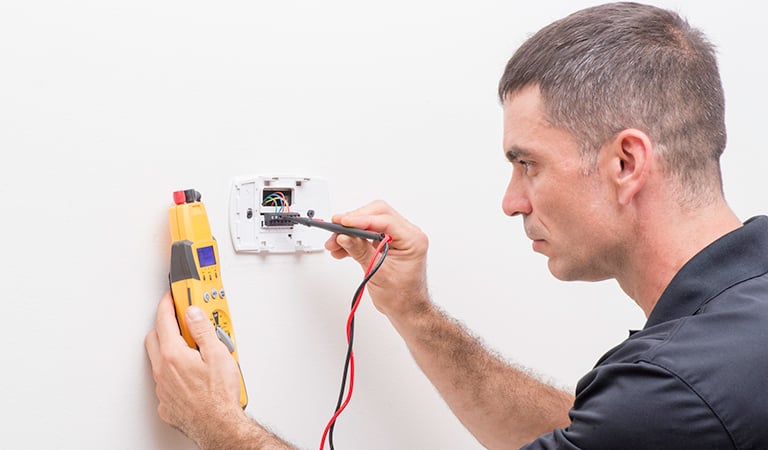
Beyond just knowing how to verify electrician licenses, it’s essential to understand why they’re important in the first place.
Electrical work requires training. A journey-level electrician must complete approximately five years of education and up to 10,000 hours of on-the-job training in many cases. Hiring a licensed electrician gives you the peace of mind that the electrician you hire will complete the work right and up to code.
When an electrician is licensed, you can feel confident knowing that they’ve passed an exam and have the necessary qualifications to guarantee good quality work. It’s also important for a few more practical reasons:
Your electrician will complete the job according to safety guidelines by the National Electrical Code, the minimum safety standard for electrical work in most states.
Licensed electricians are bonded, meaning they have a legal obligation to complete the work you hired them to do. So, if your contractor leaves without finishing the job properly, you have an extra level of assurance and can receive compensation for unfinished work.
Building codes can vary by state or community. A local licensed electrician will know the code requirements for your area and whether your job requires a permit, saving you from an unpleasant surprise down the road.
Working with an unlicensed electrician could void your homeowner’s insurance should you need to file a claim following their work.
Licensed electricians in the U.S. can be either registered, meaning they can only do work in the specific region where they are registered, or certified, which means they can work anywhere in the state where they acquired their license. Some electricians might even qualify for reciprocal licenses so they can work across state lines.
In short, registered electricians typically work in a smaller area (like one city or county) than certified electricians, who can usually work across the entire state.
Electrician licensing is pretty similar for most locations across the U.S. Typically, the process will look something like this:
You must complete an apprenticeship with anywhere between 4,000 and 10,000 hours of on-the-job and in-class work.
You must pay a licensing and/or exam fee for the license you want to obtain.
You must pass your chosen exam.
However, there are several differences that you may find across states:
Certain states require apprentices to be licensed, while other states only require journey-level electricians and above to be licensed.
Electricians can sometimes get their licenses at the city or county level rather than the state level.
In some states, there are multiple licenses for journey-level electricians, master electricians, and electrical contractors, each with its own requirements.
Some states do not have a master electrician designation, so there will be no master electrician license available in those states.
We always are skeptical when it comes to hiring a contractor, but when we hired E-electric boy inwas thrilled, Bes was such a professional , came and inspected every electric wire and he fixed them all according to the contract that we had , i recomend E-Electric to everyone

Second time I've hired this company, they replaced the entire electrical part of my business, you can hire them with the assurance of good service.
We purchased a home that was need of a bit of work and I had great difficulty finding good firms that charged fair prices and performed well. I first hired JMZ to clean the yard and cut the grass. I saw Jose's truck in the area and called the number on the side. In the past two years Jose and...
German was very helpful and professional, helping us address an urgent issue we had with needing to upgrade the electric for our new water heater. After calling many electricians because of the urgent nature and getting nowhere, we were lucky to find German who made himself available less...
Steve was great! Traveled over an hour to help us out as we had an electrical emergency and he was able to fix the problem. He was very reasonable and did an excellent job. Would use him again for any of our electrical projects.
Professional, courteous and great quality. Would hire the team again.
From average costs to expert advice, get all the answers you need to get your job done.
Get a clear estimate for attic fan repair costs to learn what impacts pricing, how to save, and whether to repair or replace your attic fan.

Find out how much it costs to install a cable outlet for TV or internet. Our expert guide breaks down the costs involved in installing a new coaxial outlet and explores how you can save and if you can do this project yourself.

The cost to install a 240-volt outlet varies depending on the amperage and the home’s current wiring conditions. Use this guide to budget for your next project.

Learn how to wire an outlet switch combo receptacle in various ways to adapt an existing wired location for several applications.

Is it acceptable to have an electrical panel in a bathroom? Keep reading to find out the best location for this essential feature.

Grounded circuits are happy (and safe) circuits, but what if you live in an older home with pre-grounded receptacles? Here are ways to ground without a wire.